Home Theater

Saturday, May 27, 2006

Coat two of five

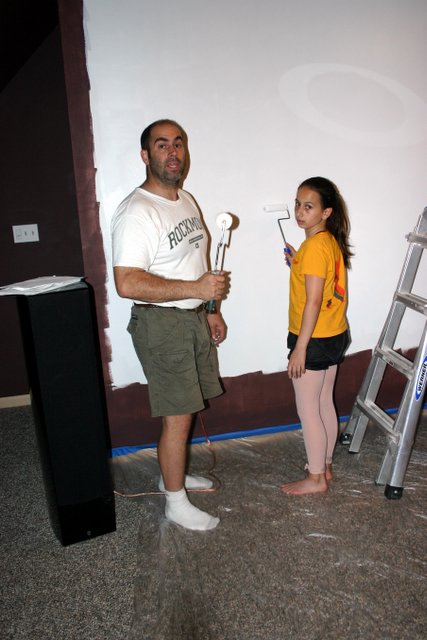
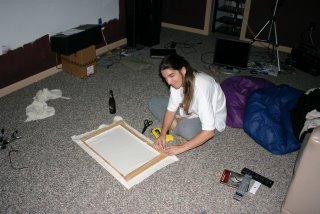
An action shot of the home theater tyrant and one of his hapless minions!

Instead of being the object of derision of a disciple of P.T. Barnum and paying $2000 for a sheet of material with a fancy name on it, we're going to use paint- empirically tested to be perfect. Three coats of primer- with sanding in between, followed by Glidden Misty Evening. The slight gray of 'ME' helps with contrast of LCD projectors, who have to shine light past an LED- some of which will leak. Total price? About $25. Worst case? I can still buy a screen. But, from everything I've read, this is the dealio... you know, yo.

  Posted by Picasa

Thursday, May 25, 2006

Soundcheck... Check 1... Check Check

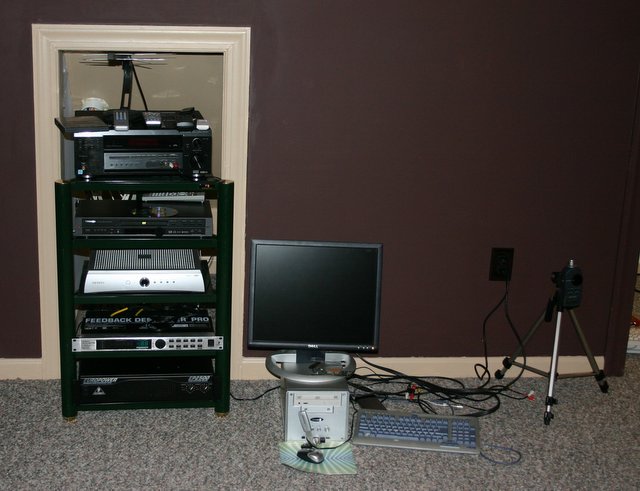
The sub is in the ceiling, the parametric equalizer is linked to the receiver and plugged into the big honking amp. But- what if the sound isn't *perfect*. That's what the equalizer is for- we can balance out the frequency response of the system. It is a pain to set up. I've had three different computers up in the theater trying to simply get what is needed to start measuring the system.

Those components are:

  • PC with a good soundcard. I took an SB Live card out of my Linux server and put it into Aidan's PC for this test. It needs to be able to handle duplex communication without signal degredation.

  • A soundmeter. I'm borrowing Eric Nelson's RS Meter, which is called a sound-pressure meter. It is pretty cool because it can measure sound pressure that you can't even hear.

  • An equalizer. Once we analyze the sound response of the room, we then need to tune the room to flatten it out. Low frequency sounds are very susceptible to peaks and nulls because they are relatively long and can interact with furniture, room dimensions and room treatments. With the equalizer, we can tame the peaks, and modify the shape of the curve to give a desired response (that would be in the bass, Bob). Mr. Stocks was so kind as to provide me with the needed midi cables.
    The Home Theater Shack has all the info you need to set up the Room Equalization Wizard (free) and the BFD (Behringer Feedback Destroyer).

    Once you get the equipment, you put the meter in your seating position at ear height (the tripod will go on the sofa). You then run through a series of tests to baseline your equipment (calibrate the meter, the sound level, the sound card), and finally use sweeping sine frequencies to measure response. I'm going to test with just the subwoofer, and then add in the rest of the speakers because there is an overlap, as the main speakers have good low-frequency response.

    Coming Soon... pics of the before and after frequency response. For now, let's just say that the bass is very satisfactory after the initial tuning.


      Posted by Picasa

  • Sunday, May 21, 2006

    Safety and Organization

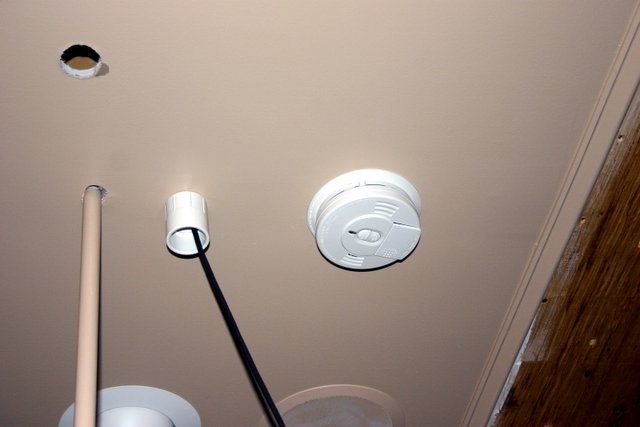
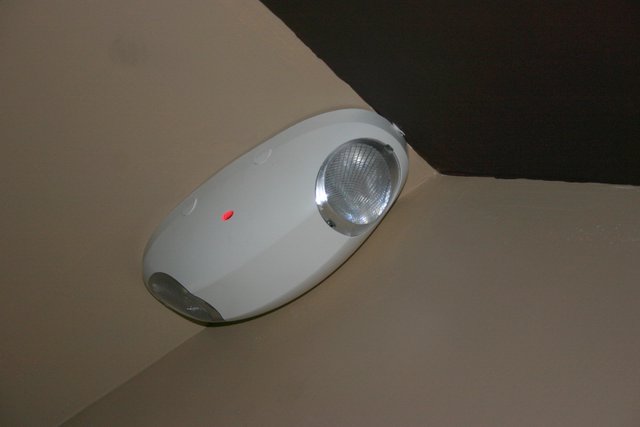
    Ever notice how theaters (soon I hope to forget them) have those exit signs everywhere? I mean, they're important, but distracting. And I remember as a kid when people used to smoke in the theater. It was kind of crazy seeing the glow of a cigarette in a dark theater. Yeah, I'm rambling, but these thoughts knocking around in my head have lead me to installing a smoke detector (both AC and DC- but who the heck is going to hang out in the HT when the power is out) and an emergency light to be able to see if you happen to be there. And finally- I *can* smoke (cigars, duh) in my own HT. So there. (But, dang it, it'll probably set off the detector)


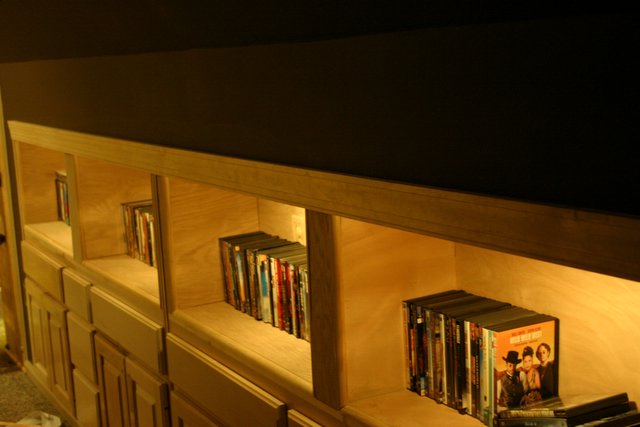
    Steff and Erin moved and organized our 200+ DVD collection. Very nice.


      Posted by Picasa

    Too much time in the ceiling

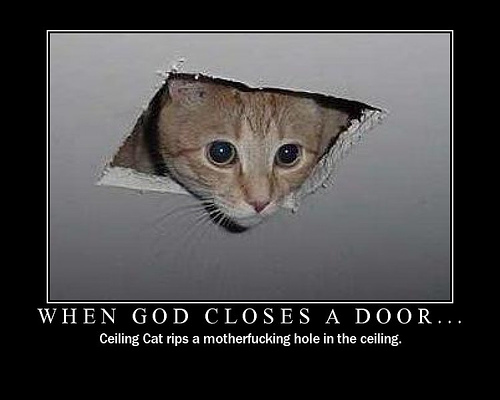
    I spent a beautiful weekend day crawling around my stifling hot attic, running wiring and putting in *more* holes (upcoming post). Mr. Stocks showed me this picture and I found it hilarious (probably due to heat exhaustion roasting my brain).


    (sorry for the bad language)

    Friday, May 19, 2006

    IB Sub and The WAF


    One of the obstacles to true enlightenment in the audio-visual realm is the WAF. The Wife Acceptance Factor. All guys know that the correct-sized speaker is actually floor to ceiling. This ideal speaker should also have spikes and razor sharp edges to keep people from getting to close (for their own safety). A well-designed speaker will also have lots of LED lights which blink depending on which of 17 different crossovers are activated (floor to ceiling, remember- you think it'll just be a 3-way?). Even the audio purist wants these LEDs because he'll just close his eyes when listening to music. These speakers, since they'll last a lifetime, should cost the equivalent of a college education.


    But, that's when the WAF comes in. The Wife will often talk about insignificant topics like decor, and style- they'll even go so far as to complain that the spikes and razor edges on the speaker are a (get this) hazard to guests, children and pets (when you very well know, it is the speakers that are at risk!). Then we hear about budget and that the equivalent money of a college education should actually pay for college!

    This 'WAF' is the reason most guys end up with a pair of bookshelf speakers meant to look like a potted plant or other such nonsense.

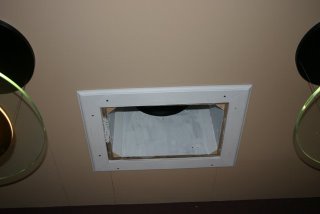
    Which brings us to the IB sub. This is one place that you can do what you want... since the speakers are outside the actual viewing area- the Wife doesn't know that there's actually 12 drivers in the basement. Or that one of you speakers is bigger than a CRT projector. As far as cost- you can start for pretty cheap- just build your manifold to hold the number of drivers you want and then add on. The cost is better than a lot of box subs- which *violate* WAF because they take up space in the room. And, when building it, you're doing stuff around the house. Oh, and you can put all the LEDs on it you want. But, as shown above, it'll probably have a cover over it.

    In my case, the whole WAF thing is false. Stefanie wanted *bigger* speakers in the living room. I was going to move the speakers that were there into the home theater, but they weren't big enough so we had to get new ones. Here she is making the grill cover for the IB opening.

    What we did is just put up some trim around the outside of the manifold. Then we took some rounded trim and made it slightly smaller than the outside diameter. To keep it stiff we glued small strips of wood behind the corners. I picked up some aucousticly-transparent speaker cloth from a local shop. Steff is shown stretching and stapling it to the frame. Start from the center and work to the corners to keep it taut. We're going to finish by putting velco on the frame and cover just in case I do want to install and see LED lights.

    Posted by Picasa

    Labels:

    Sunday, May 14, 2006

    No ladder!

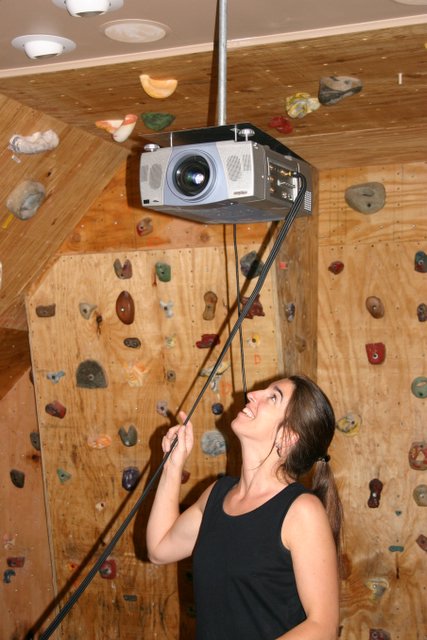
    What started off as a quick proof-of-concept ended up being our projector stand for the last couple of months. We had two ladders set up like a scaffolding with boards in between them- and the Sanyo PLV-60HT sitting between them. What's worse is that we had to use the ladders for other tasks and had to break down and set up this system again. Mr. Stocks was kind enough to let us have his setup, and I did the attic crawl to make a mounting point up in the ceiling. Check out the Polk In-Ceiling speaker next to the fish eyes. What is in the background is the bouldering wall we built a while ago. For the home theater, the next step is to run cables (Jerry has given me some links to make my own if the ones I have aren't long enough). What I really want is a motorized mount. I want to do this just for the cool factor- as where it is now is high enough to be out of the way and really isn't in danger of interfering with the climbing gym. But to be able to push a button and have it lower.... aaaah. Maybe I could add some LEDs

    -frederick

    Thursday, May 04, 2006

    Heavy Metal

    Whoa! Just got my amp and DSP from Audio Allies. Got a great price, and it was an internet shop- who is local. This thing is fricking heavy- the amp weighs 58 pounds. It is 2400 Watts- and even though I didn't need that much... it was only like $30 more than the 1200 Watt version.The DSP is the Behringer DSP1124P, a digital parametric equalizer. It has lots of LEDs. :D It going to take some tweaking to get it set up for the room. I need to borrow a sound meter and then run a series of tests to program the DSP to match my room.

    I bought some XLR cables from a stereo place downtown- along with some banana jacks to use to run the wire up to the subs. XLR is cool because they're a three-conductor connector, which means they're 'balanced'. Posted by Picasa